Vacuum Trucks · Shacman 6x4 vacuum sewage truck
Shacman 15,000 Litres 6x4 Vacuum Sewage Suction Truck for Municipal and Industrial Waste
The Shacman 6x4 is the heavy single-purpose suction platform alongside our combined jetting truck: a 15 m3 Q235 tank on a 31 t GVW chassis with hydraulic lifting, sized for municipalities and industrial sites that collect more and jet less. Anti-overflow protection and sight-glass monitoring keep loading disciplined.
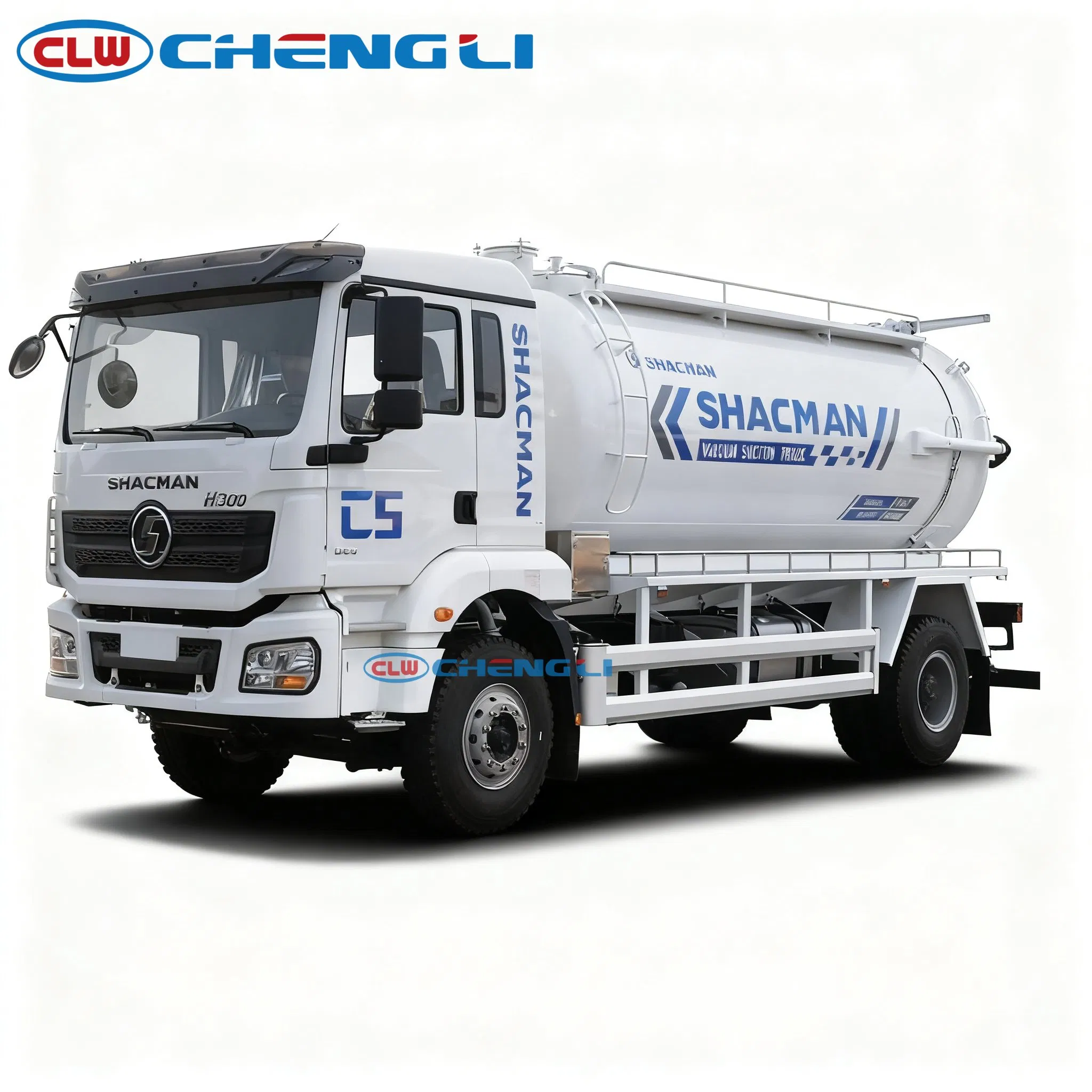
Core capabilities in operation
Technical parameters translated into working results. Figures are reference estimates and vary with operating conditions.
| Parameter | Working result | Calculation conditions | Factors that change the result |
|---|---|---|---|
| 15 m3 Q235 tank on a 31 t GVW chassis | About 11,300 kg of rated payload per trip, collecting roughly 11 m3 of typical sludge before hitting the weight limit, with the balance of tank volume as headroom. | GVW 31,000 kg minus 19,570 kg curb weight; sludge density above 1.0 kg/L. | Sludge density, water content and hauling distance. |
| Hydraulic tank lifting system | Tips the tank for fast gravity discharge at treatment points, cutting turnaround versus pumping out. | Operation on level, stable ground. | Site layout and discharge practice. |
| Anti-overflow valve with sight glass | The anti-overflow valve and liquid sight glass keep the vacuum system safe when the tank fills, protecting the pump from liquid carry-over. | Standard functional equipment as listed. | Operator practice and maintenance. |
| Shacman 6x4 with Weichai 350-460 HP band | Heavy-platform reliability for full 15 m3 regional runs, with the engine rating matched to the haul profile at order. | Engine band confirmed per order. | Gradient, distance and service network. |
Technical specifications
| Manufacturer | CLW (Chengli Special Automobile) |
|---|---|
| Chassis brand | Shacman Shacman 6x4 heavy platform |
| Drive layout | 6x4 |
| Engine brand | Weichai |
| Engine model | Weichai, 350-460 HP band (confirmed per order) |
| Fuel type | Diesel |
| Wheelbase | 1800 + 3000 + 1400 mm (1950+4200+1400 alternative) |
| Gross vehicle weight | 31 000 kg |
| Curb weight | 19 570 kg |
| Dimensions (L×W×H) | 11 998 × 2 550 × 3 998 mm |
| Maximum speed | 89 km/h |
| Capacity | 15,000 litres (15 m3 Q235 carbon steel tank, anti-rust treated) |
Body and tank specifications
| Paint | Anti-corrosion, waterproof coating |
|---|---|
| Tank capacity | 15,000 L |
| Tank lifting | Hydraulic tank lifting system available |
| Tank material | Q235 carbon steel with anti-rust treatment |
Additional chassis specifications
| Axle note | Three-axle 6x4 layout per wheelbase and 31 t GVW; listing header shows 4x2, resolved to spec evidence |
|---|---|
| Gearbox | 6-speed or 8-speed manual |
| Seating capacity | 2-3 |
| Tire specification | 11.00R20 / 12.00R20 / 12R22.5 18PR options |
Working system specifications
| Control | Manual plus electrical control |
|---|---|
| Functional equipment | Anti-overflow valve, pressure gauge, liquid sight glass, working light, warning light |
| Optional equipment | High-pressure cleaning function, hose reel, high-pressure water pump, clean water tank |
Configuration options and trade-offs
- Engine: Weichai 350-460 HP band; confirmed per order
- Jetting option: High-pressure cleaning package, hose reel and water tank optional
- Wheelbase: 1800+3000+1400 standard; 1950+4200+1400 alternative
- Emission standard: Euro 2 to Euro 6 band; confirmed per destination
Where this vehicle works well
Suitable conditions
- Municipal sewage and septic collection with longer regional hauling
- Industrial wastewater transport from plants to treatment points
- Fleets that collect more than they jet (see the combined jetting truck for flush-and-collect work)
Not recommended for
- Drain-line jetting work better served by the combined sewer cleaner
- Hazardous chemical waste outside the sewage scope without reconfiguration
Delivery and shipping
| Shipping methods | RORO: Roll-on/roll-off shipping to Lagos · Flat rack: Container flat rack for shared shipments |
|---|---|
| Destination port notes | Common delivery ports for Nigerian orders include Lagos Apapa and Tin Can; the final shipping plan is confirmed with the quotation. |
Frequently asked questions
How much sludge can it collect per trip?
About 11,300 kg of rated payload; with typical sludge densities above water, that is roughly 11 m3 per trip with the rest of the 15 m3 tank as headroom.
How does it discharge?
A hydraulic tank lifting system tips the body for gravity discharge, and the rear outlet supports pumping discharge where sites require it.
What protects the pump when the tank fills?
The anti-overflow valve and liquid sight glass stop liquid reaching the vacuum pump; a pressure gauge and working light support operation.
Can it also jet drains?
High-pressure cleaning function, hose reel, water pump and clean-water tank are optional; for flush-and-collect-in-one-visit work, the combined sewer jetting truck is the dedicated build.
Why a 6x4 for sewage work?
The 31 t GVW platform carries the 15 m3 tank with legal axle loads on regional hauls; the listing header showed 4x2, but the three-axle wheelbase and GVW define the actual layout.
Collect more, jet less
Not every sanitation crew needs a combined jetting machine. Where the work is collecting sewage, sludge and industrial wastewater and hauling it regionally, a single-purpose suction platform on a heavy chassis does the job with less complexity: the Shacman 6x4 carries a 15 m3 anti-rust Q235 tank with hydraulic lifting and disciplined loading through the anti-overflow valve and sight glass.
Jetting capability remains available as an option package, and the Weichai engine band is matched to the haul profile at order. Request a quotation with your sludge type, volumes and destination port.
Verification and support
Vehicle data on this page is mapped from the manufacturer's product centre. Tank material, emission standard and compartment layout are confirmed per order; final specifications, documentation and certification are subject to the technical agreement and destination-market requirements.